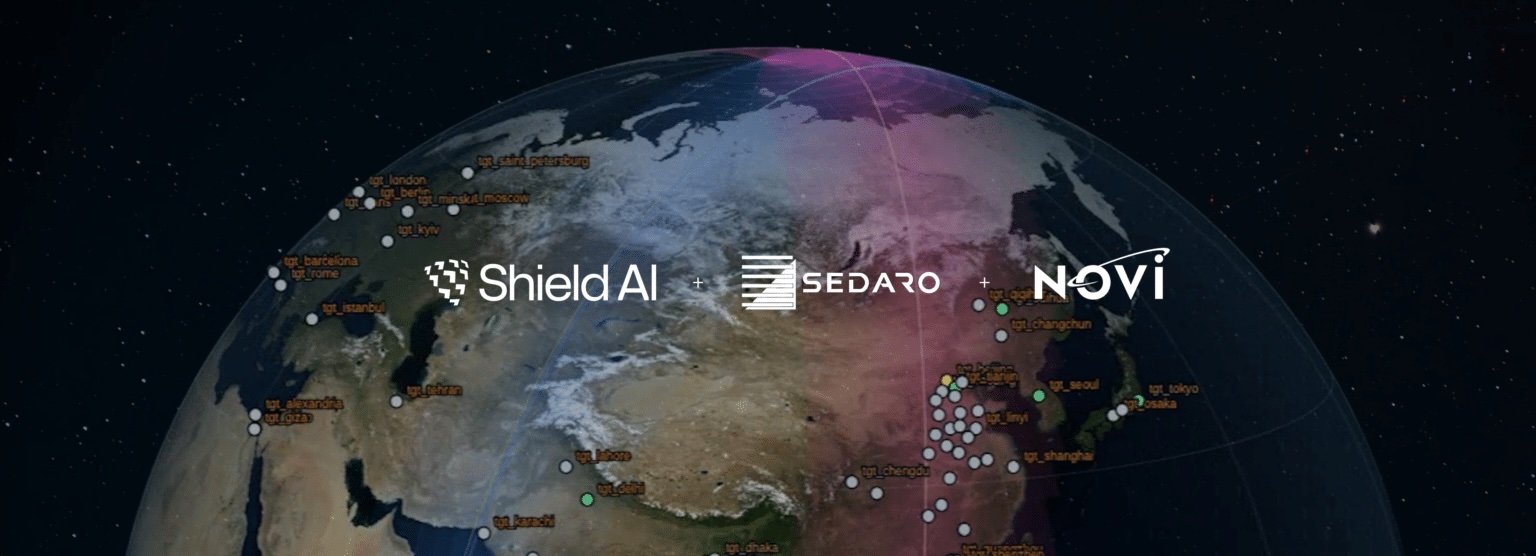
Shield AI’s Hivemind autonomy software has flown in orbit for the first time, controlling mission operations aboard a NOVI Space satellite during an autonomous space operations demonstration.
It marked both the highest-altitude and longest-duration Hivemind deployment to date, extending Shield AI’s autonomy technology from airborne platforms to an operational satellite in low Earth orbit.
Working with Sedaro and NOVI Space, Hivemind performed multi-objective optimization across a six-satellite constellation, balancing imaging tasks, spacecraft health, battery state of charge, and pointing. NOVI’s satellite served as the leader alongside five virtual spacecraft.
Over 24 hours, the system generated 189 commands that were approved by Sedaro’s Autonomy Framework for the Edge (SAFE) before execution. SAFE also provided autonomous decision validation during the experiment.
In a second trial, SAFE and Sedaro’s Edge Deployable Simulators ran a similar multi-objective optimization and increased the satellite’s Iridium communications contact initiation by 8 percentage points.
Validating Autonomous Space Operations
The demonstration marks Hivemind’s first deployment in the space domain, extending Shield AI’s autonomy technology beyond aircraft.
Shield AI and Sedaro announced their strategic partnership in late 2025, naming Hivemind as Sedaro’s preferred autonomy software for on-orbit demonstrations.
Satellite constellations supporting communications, Earth observation, and national security missions are still largely managed through manual workflows. Sedaro identifies trust as a key challenge for autonomous space operations.
“The hardest part of autonomous space operations is trust,” said Robbie Robertson, chief executive and co-founder of Sedaro.
“By providing a predictive, onboard model of the spacecraft and its environment, SAFE and our Edge-Deployable Simulators let operators validate autonomous decisions before they execute.”
The technology was developed under a Phase II Small Business Innovation Research award through SpaceWERX.