Artificial intelligence is taking on a bigger role in hypersonic warfare, with US defense firm Aurex advancing two AI systems that simulate strike missions and battlefield decisions before they happen.
The platforms, GHOST-AI and CASTER-AI, model both hypersonic vehicle behavior and mission-level combat scenarios, allowing users to assess tactical engagements, plan strike packages, and evaluate defensive system performance.
Two AI Systems, Different Roles
GHOST-AI, short for Generalized Hypersonic Optimizer for Survivable Trajectories, uses reinforcement learning to develop adaptable guidance, navigation, and control behaviors for hypersonic vehicles.
It trains across simulated environments without mission-specific pretraining.
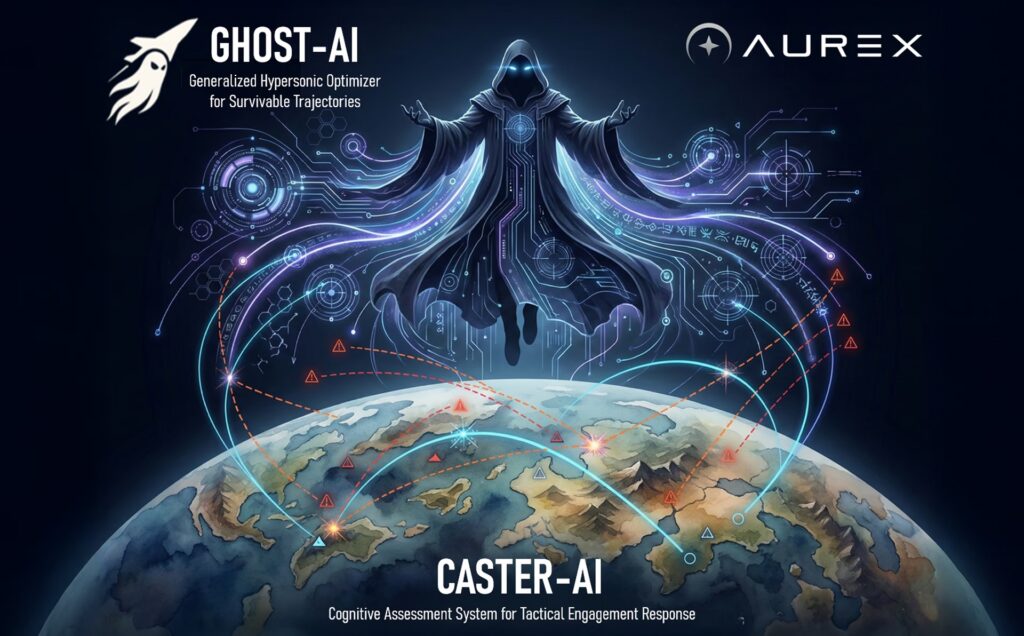
CASTER-AI focuses on mission planning and tactical decision support, handling tasks such as resource-to-target pairing, strike package planning, and pre-mission analysis.
It also supports defensive system assessments and fire-control decisions.
According to Aurex, CASTER-AI integrates GHOST-AI agents to control simulated hypersonic vehicles, cruise missiles, and other munitions, linking mission-level battle management with AI-driven weapon behavior.
“Aurex is using AI not only to discover solutions, but also to translate those insights into explainable, testable algorithms for future guidance, battle-management, and fire-control applications,” said Aurex chief executive Warren Kohm.