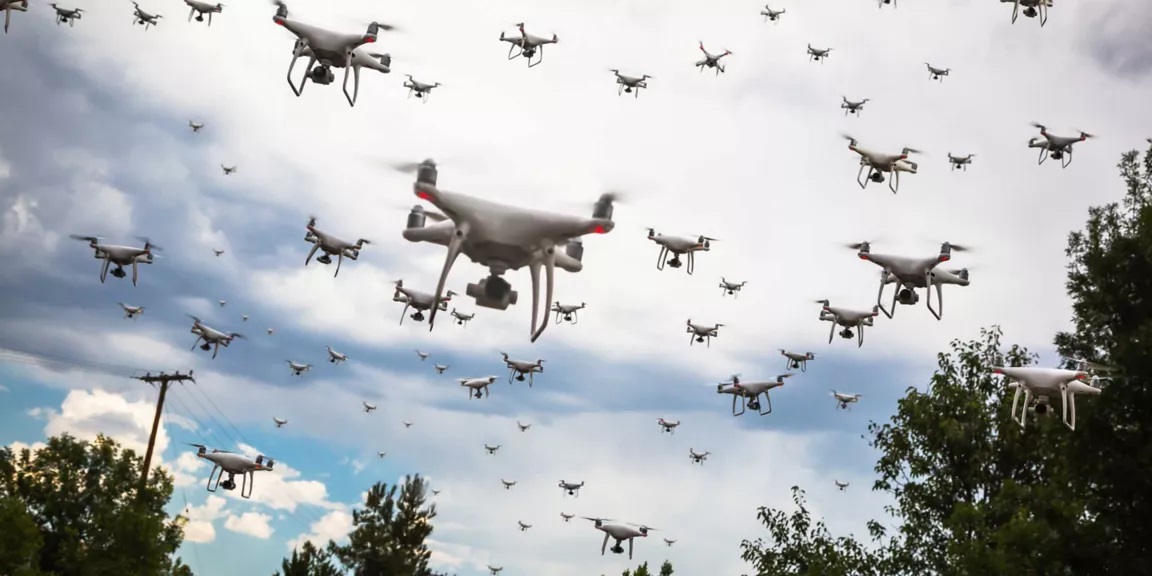

Honeywell has launched an innovative artificial intelligence (AI)-enabled solution designed to neutralize unmanned aerial system (UAS) swarms.
Named the Stationary and Mobile UAS Reveal and Intercept, the system combines beyond-visual-line-of-sight communication with advanced command-and-control capabilities to effectively detect, track, and counter drone swarms.
It integrates cutting-edge components, such as radars, radio frequency defeat capabilities, and AI-driven detectors for enhanced threat monitoring.
The weapon can be mounted on vehicles or deployed in fixed positions to protect high-value assets.
According to Honeywell electronic warfare director Norm Balchunas, the system can detect and neutralize drones while traveling at speeds reaching 70 miles (112 kilometers) per hour.
That capability is significant, he noted, because detecting a low, slow drone that suddenly accelerates poses a considerable challenge.
‘Multi-Layered Defensive Capabilities’
Unlike other counter-UAS solutions, the Stationary and Mobile UAS Reveal and Intercept system features multi-layered defensive capabilities to address multiple threats simultaneously.
It can disable drones by launching a kinetic interceptor, utilizing a directed energy weapon, or employing a soft kill method to disrupt their radio frequency.
AI also plays a crucial role in the system, enabling rapid threat detection in crowded environments and accelerating human operators’ decision-making.
“[The operators] got to make a decision. What target path is that? What effector should I use? Is this authorized within my rules of engagement?” Balchunas said. “Using AI, I can implement my rules of engagement so they’re automated.”
Honeywell is set to demonstrate the ground-breaking system to the US Air Force in January 2025.