Japanese multinational NEC is developing an underwater acoustics foundation model designed to bring generative AI capabilities similar to large language models to underwater acoustic data.
NEC has been awarded a contract by Japan’s Acquisition, Technology, and Logistics Agency under its Innovative Breakthrough Research program to develop the model using self-supervised learning.
AI Learns From Underwater Sound
Underwater environments are difficult to analyze because light and radio waves barely penetrate water, making sound a key tool for observing activity below the surface.
Sonar and hydrophones generate large volumes of acoustic data, but analyzing those signals requires specialist expertise and can be time-consuming.
Traditional AI models also depend heavily on labeled training data, which NEC said is particularly challenging to collect for underwater acoustics.
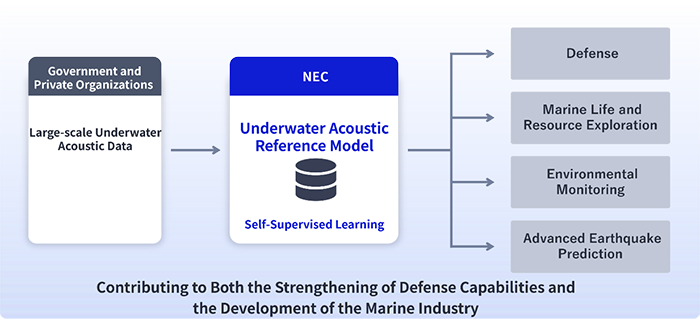
The new approach uses self-supervised learning to train on large volumes of data without extensive labeling.
NEC will collect training data through public-private partnerships, allowing the model to learn from large volumes of underwater acoustic data.
AI-Powered Ocean Digital Twin
NEC said the foundation model could enable faster, more precise understanding of underwater phenomena and help create a digital twin of the ocean.
The technology is being developed for dual-use applications, with potential uses spanning defense, marine-life research, resource exploration, environmental monitoring, and high-precision earthquake prediction.
NEC is drawing on more than 90 years of sonar technology experience and its proprietary cotomi AI technology.
The company will work with Japan’s Defense Innovation Science and Technology Institute to develop and demonstrate the foundation model, with completion targeted for fiscal year 2027.